What Is Uphold? How the App Works, What It Costs and How Safe It Is
Uphold is a custodial money app that lets you convert between crypto, ordinary currencies, precious metals and, in the US, stocks, usually in a single step and without an order book. Instead of a separate trading fee, most of what you pay is built into the exchange rate as a spread: Uphold lists typical spreads of 2.05% to 2.2% for bitcoin and ether in the US, as checked on 9 October 2026. That makes it simple and flexible, but more expensive per trade than an order-book exchange. It suits someone who values convenience and likes moving between asset types; frequent traders and anyone who wants to hold their own keys should look elsewhere. This is an explainer, not financial advice, and crypto can lose all of its value.
Short answer: what Uphold is
In plain terms, Uphold is a broker-style app that holds your assets for you and swaps them at prices it quotes. On its US site, read on 9 October 2026, it advertised more than 300 cryptoassets, more than 4,000 stocks and ETFs, gold and silver, and 27 currencies. The US business, Uphold HQ Inc., is a licensed money transmitter registered with the NMLS under number 1269875. Stock trading runs through a separate broker-dealer, Uphold Securities, Inc., and some accounts are provided through Atomic Brokerage LLC, while the debit card is issued by Cross River Bank. Uphold itself states that it "is not a bank" and is not FDIC insured.
Because Uphold is custodial, it holds the keys to the crypto in your account, in the same way an exchange does. That is the first thing to understand about any app of this kind, and our explainer on crypto wallets versus exchanges covers what it means for your risk.
How Uphold works: anything-to-anything trades
The feature Uphold is known for is converting directly between unlike assets. On a typical exchange, turning one altcoin into gold or euros might take several trades through a base currency, each with its own fee. Uphold presents it as one conversion: you choose what you hold and what you want, see a quote, and confirm.
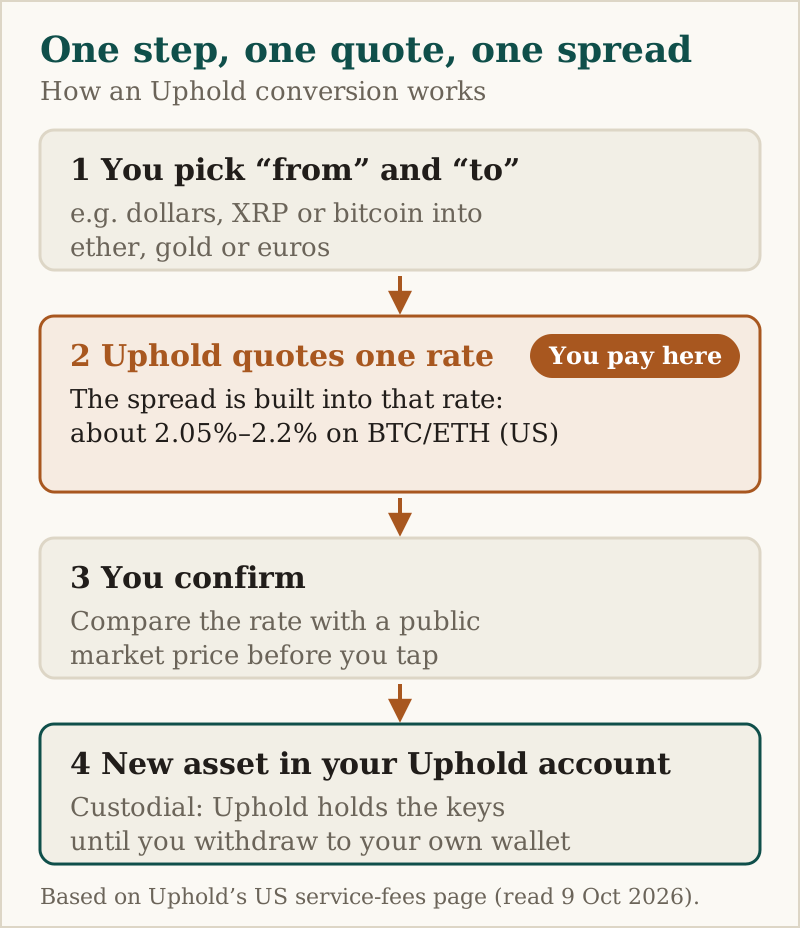
The convenience is real, but so is the trade-off. Because the price you see already includes Uphold's margin, there is no separate fee line to compare, and the cost of a conversion between two volatile assets can be higher than a single crypto purchase. The quote screen is the place to check: compare the rate shown with a public market price before you confirm.
What Uphold costs: spreads, with a worked example
Uphold publishes "typical" spreads by asset type rather than a fixed fee. On its US service-fees page, checked on 9 October 2026, the ranges were 2.05% to 2.2% for bitcoin and ether; 2.85% to 3.8% for other cryptoassets; under 0.25% for other stablecoins; 2.35% to 3.40% for precious metals; and 0% for converting between US dollars and supported US-dollar stablecoins at one-to-one, up to $20,000 per customer per rolling month. Uphold describes the figures as typical, so the spread on a given trade can differ.
| What you convert | Typical spread | Cost on a $1,000 conversion |
|---|---|---|
| Bitcoin or ether | 2.05% to 2.2% | About $20.50 to $22.00 |
| Other cryptoassets | 2.85% to 3.8% | About $28.50 to $38.00 |
| Other stablecoins | Under 0.25% | Under $2.50 |
| Gold, silver and other metals | 2.35% to 3.40% | About $23.50 to $34.00 |
| US dollars to supported USD stablecoins | 0% (up to $20,000 per rolling month) | $0 |
Here is how that plays out. Say you convert $1,000 into bitcoin when the market price is exactly $100,000 (a round, made-up number). At a 2.05% spread you effectively pay $20.50 for the conversion, so you receive about $979.50 worth of bitcoin at the market price, or roughly 0.0098 BTC. If you sold it straight back, you would pay a spread again on the way out, so a round trip costs roughly twice the one-way spread before the price has moved at all. On an altcoin at the top of Uphold's 3.8% range, the one-way cost on $1,000 would be about $38.
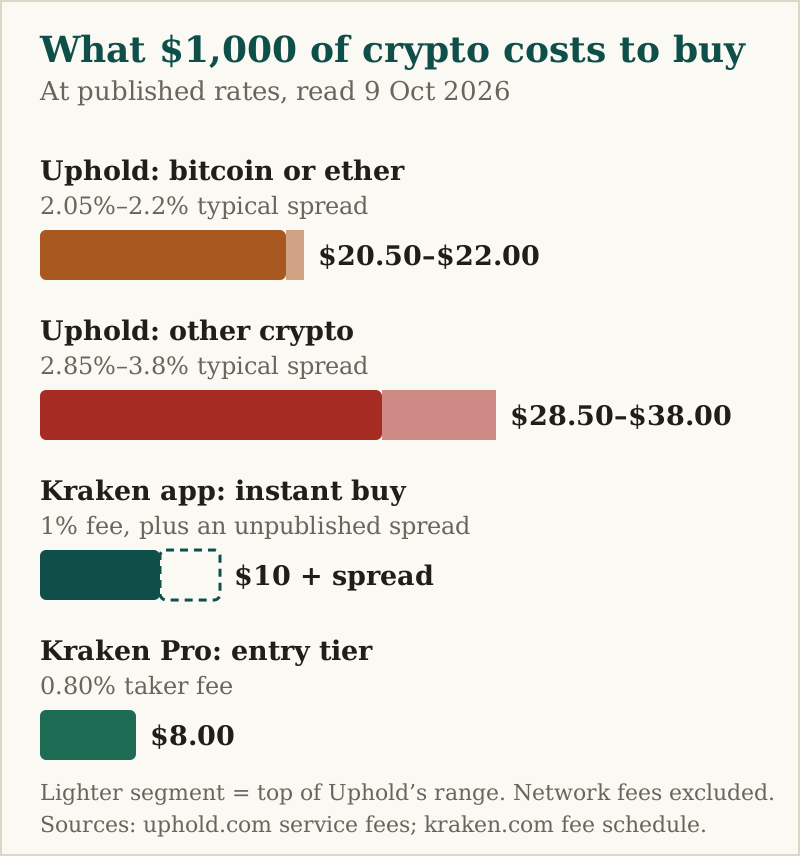
For comparison, Kraken's published schedule, read the same day, charges 1% on instant buys in its app (plus a spread it does not quantify) and 0.40% maker / 0.80% taker at the entry tier of its order-book platform, Kraken Pro. Order-book trading usually costs less per trade, but asks you to deal with order types and a busier screen. Card purchases, withdrawals to outside wallets and network fees are extra on every platform, so check the final quote.
Staking is the other place Uphold takes a cut. Its fee page says it takes a 50% commission on Flexible staking rewards and, from 15 October 2026, 35% on Boosted staking rewards. Any staking rewards are variable and not guaranteed, and a commission of a third to a half of them is high, so read the terms before locking anything up.
Is Uphold safe? Regulation, reserves and limits
"Safe" has two parts: is the company properly authorised where you live, and how protected are your assets if something goes wrong? Uphold's answers differ by country.
- United States: Uphold's regulators page, read on 9 October 2026, lists money-transmitter licences (or equivalents) in more than 40 states plus Washington DC and Puerto Rico. New York was not on that list, and California's licence under its new digital-asset law was shown as "Application Pending." Check your own state before signing up.
- United Kingdom: Uphold Europe Limited is registered with the Financial Conduct Authority for anti-money-laundering purposes only (FRN 938277). Its UK footer says its cryptoasset services are unregulated, and its UK pages carry the warning: "Don't invest unless you're prepared to lose all the money you invest."
- Canada: Uphold's site says Uphold Operating Canada Ltd. withdrew its registration application in certain Canadian jurisdictions and no longer offers registrable services to Canadian residents.
On reserves, Uphold says its platform is "always fully reserved" and has been "provably reserved since 2014," and it publishes a real-time transparency page of assets and liabilities. That is more disclosure than many apps offer, but it is Uphold's own claim: a live balance display is not the same as an independent audit, and it cannot show how customers would be treated in an insolvency. Crypto held with Uphold is not covered by government deposit insurance, and brokerage protections attached to its securities business should not be assumed to extend to crypto balances.
Plainly put: Uphold is a regulated money transmitter in much of the US, a lightly registered firm in the UK, and absent in parts of Canada. "Safe enough" turns on where you live and how much you leave with any single company.
What you can and can't do in your country
Products vary more by country than the marketing suggests. Stocks and ETFs are offered on Uphold's US site through its broker-dealer. The Uphold debit card, according to Uphold's card page read on 10 October 2026, is available only to US residents and not in Louisiana, New York or US territories. Uphold says no credit check is needed, offers a $0 "Essential" card and a $99.99-a-year "Elite" card, and pays rewards in XRP on card spending, at rates it advertises as "up to" figures that depend on the card and the funding source. Two practical points from the same page: spending crypto through the card is a sale for US tax purposes, and the rewards are paid in a volatile token, not cash.
Staking, card rewards and stock trading each have their own state and country exclusions, so the honest rule is to treat Uphold's country-specific site and the in-app eligibility screens as the final word, and to recheck them before you move money.
Uphold vs Coinbase in one table
Coinbase is the comparison most people make, so here is how the two line up on points we could verify from primary sources. Coinbase does not publish a fixed spread percentage; its annual report says it charges consumers a spread plus fees, with Simple trades generally costing more than its Advanced platform, and it shows the total before you confirm.
| Uphold | Coinbase | |
|---|---|---|
| Pricing model | Spread built into each quote; typical ranges published | Spread plus fees on simple trades; lower fees on Advanced |
| Published BTC/ETH cost | Typical spread 2.05% to 2.2% (US) | Not published as a fixed rate; shown before you confirm |
| Asset range | 300+ crypto, 4,000+ stocks/ETFs, metals, 27 currencies | Crypto, plus stocks, futures and prediction markets added during 2025 |
| Custody | Custodial; says fully reserved, real-time transparency page | Custodial; says it holds assets one-to-one, SEC-filed reports |
| Company status | Licensed US money transmitter (NMLS 1269875) | Nasdaq-listed since April 2021; founded 2012 |
| Staking commission | 50% Flexible; 35% Boosted from 15 Oct 2026 | 35% standard; lower for Coinbase One members (checked 10 Oct 2026) |
If low trading cost matters most, an order-book exchange is usually cheaper than either app's simple-buy screen. If you want an established, heavily disclosed exchange as an alternative, Coinbase and Kraken are both options; both are affiliate links (Plainchain may be paid if you sign up, you pay nothing extra, and it does not shape this explainer), and Kraken does not serve residents of New York or Maine. This site has no affiliate relationship with Uphold, so nothing on this page is paid for by Uphold.
Risks and what can go wrong
- Price risk: crypto prices can fall sharply and stay down; you could lose everything you put in.
- Cost drag: a 2% to 4% spread on each conversion, paid again when you convert back, adds up quickly if you trade often.
- Custody risk: while your crypto is on Uphold, Uphold holds the keys, and your protection in a failure depends on its terms and the law where you live, not on deposit insurance.
- Availability risk: products and whole countries can be withdrawn, as the Canadian notice shows, so keep an eye on notices and don't rely on one platform for everything.
- Scam risk: criminals impersonate every popular app; no genuine support agent will ask for your password, a one-time code or for you to move funds to a "safe" wallet.
None of this means Uphold is unusually risky; most custodial apps share these risks. It means the convenience comes with a price and a dependency, and both are easier to manage when you know they are there. For a broader checklist before using any platform, see our guide on whether crypto is safe and legal.
Uphold: quick answers
What is the Uphold app?
Is Uphold legit and safe?
How much does Uphold charge?
What do I need to sign up for the Uphold debit card?
Is Uphold better than Coinbase?
New here? Start with what cryptocurrency actually is, or read the whole plain-English primer. None of this is financial advice, and it never tells you what to buy.