What Does Coinbase Do? How It Works, Earns Money and Holds Coins
What does Coinbase do? It runs a US-listed crypto exchange: you send it dollars or other currency, it lets you buy, sell and hold bitcoin and other cryptoassets in an account it keeps for you, and it charges for each trade through fees and a spread built into the price. Around that core it now sells a subscription, staking and stablecoin rewards, cards, a separate self-custody wallet and, since December 2025, stocks, futures and prediction markets.
So the plain answer to 'what is Coinbase' is a broker and custodian rolled into one app. It suits people who want a well-known, regulated place to buy crypto with a bank card or transfer. It suits less well anyone who wants the lowest trading cost, or who wants to hold their own keys, which is a different product. None of this is advice to buy crypto: prices swing sharply, and the whole amount you invest can be lost.
Short answer: the company in five facts
Coinbase, Inc. was founded in 2012, and its parent company's shares have traded on Nasdaq under the ticker COIN since a direct listing on 14 April 2021, according to its 2025 annual report (Form 10-K). Being a public company means it files audited accounts and risk disclosures with the US Securities and Exchange Commission, which is where most of the numbers on this page come from.
In 2025 it averaged 9.2 million monthly transacting users and ended the year with $376 billion of customer assets on its platform. By 30 June 2026 that figure was $246 billion, and Coinbase reported a record 10.3% share of crypto trading volume in its second-quarter results. In New York it holds the state's virtual-currency licence and a money-transmitter licence, both dating from January 2017 according to the state regulator's list, and in the EU its Luxembourg entity is authorised under the MiCA regulation.
The SEC sued Coinbase in 2023 and dismissed that civil case on 27 February 2025. A dismissed lawsuit is not a safety rating; it simply removed one legal overhang. What protects you as a customer is the custody arrangement and your own security habits, both covered below.
What you can do on Coinbase: the products map
Coinbase's investor site lists its consumer products separately: buy and sell, trade, earn, a wallet, Coinbase One, a credit card and a debit card. The single most important line on that map is the one between the custodial account, where Coinbase holds your crypto, and the wallet app, where you do.
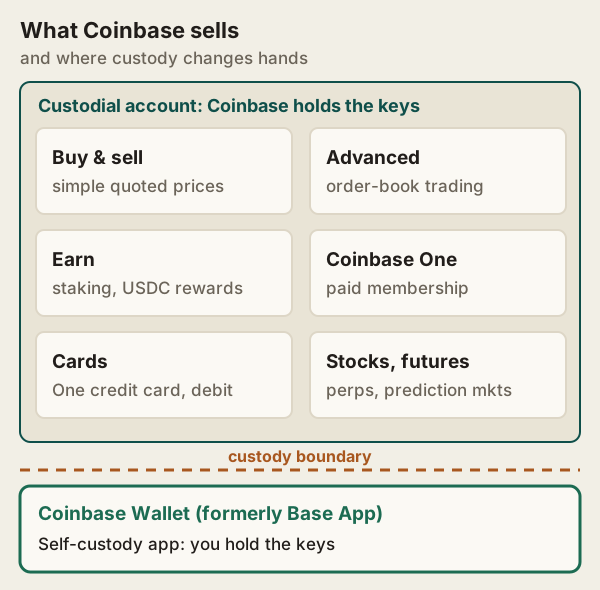
Buy and sell is the simple screen most people start on. You pick an amount, see a quote, and confirm. Advanced is the order-book screen for people who want limit orders and lower per-trade costs. Earn covers staking, where Coinbase locks certain coins into a network's validation process for you and passes on part of the reward, and rewards paid on balances of USDC, a stablecoin pegged to the US dollar.
Coinbase One is a paid membership with tiers from $4.99 a month that removes trading fees up to a monthly cap and adds other perks. The Coinbase One Card is an Amex-network credit card, with First Electronic Bank as the issuer, that you can only open and keep while you hold an eligible paid membership. In December 2025 Coinbase also added stocks, prediction markets and several kinds of futures, perpetuals included, to the same app, part of what it calls becoming the Everything Exchange; availability depends on where you live.
Coinbase Wallet is different in kind. It is a self-custody app: the 10-K describes keys stored on your own device or personal storage, not with Coinbase. For a while in 2025 Coinbase called it the Base App; its developer pages have since gone back to the Coinbase Wallet name, describing it as the app previously called Base App. If Coinbase the company vanished, coins in that wallet would still be yours, provided you kept your recovery details safe.
How Coinbase makes money
Coinbase earns in two broad ways, and the balance between them is shifting. Transaction revenue is what you pay to trade. Subscription and services revenue is everything else: revenue tied to the USDC stablecoin, its cut of staking rewards, Coinbase One fees and interest income. The chart below uses the revenue note in the 2025 10-K.
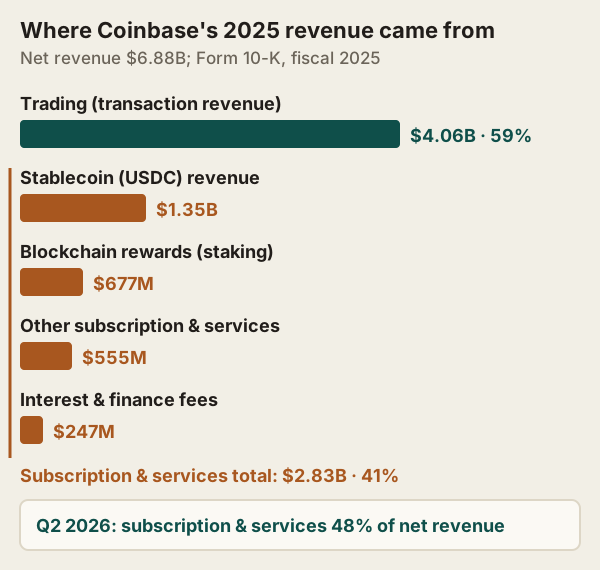
In 2025 Coinbase reported total revenue of $7.18 billion and net revenue of $6.88 billion. Trading brought in $4.06 billion, or 59% of net revenue, down from 63% the year before. Subscription and services brought in $2.83 billion, 41%, of which $1.35 billion came from the stablecoin, $677 million from blockchain rewards and $247 million from interest and finance fees. The trend continued into 2026: in the second quarter, transaction revenue was $599 million against $555 million from subscription and services, which reached 48% of net revenue, and the company reported a net loss of $359 million for the quarter.
What this means for you is worth spelling out. When you trade, you pay a fee and a spread. When you hold USDC, Coinbase books stablecoin revenue and passes a variable reward to eligible holders. When you stake, Coinbase keeps a commission on the rewards before they reach your balance. None of this is hidden, but it is spread across several lines, so the true cost of using Coinbase depends on which of these you use.
Fees in plain numbers (dated)
Coinbase does not publish a single fee percentage for simple trades. Its help pages say a spread is built into the quoted price and that the fee varies by payment method and trade, and the 10-K says simple-trade fees are generally higher than Advanced ones. The table lists what Coinbase's own pages showed to a US reader on 10 October 2026.
| What you do | What Coinbase charges | Notes |
|---|---|---|
| Simple buy or sell | Spread built into the quote, and a separate Coinbase fee | Shown on the preview screen; varies with payment method, order size and asset |
| Simple limit order | 1% limit-order execution fee | Charged on each limit buy or sell; Coinbase says it may also charge a 1.875% Coinbase fee, varying by payment method |
| Advanced trading | No spread; maker and taker fees | Fee tiers depend on volume; see Coinbase's Advanced fee page |
| Holding crypto | No separate storage fee | Per the 2025 Form 10-K |
| Staking | 35% commission on rewards (standard) | ADA, ATOM, AVAX, DOT, ETH, MATIC, SOL, XTZ; lower for some Coinbase One tiers |
| Coinbase One Basic | $4.99 a month or $49.99 a year | Zero trading fees up to $500 a month; the spread still applies |
| Coinbase One Preferred / Premium | $29.99 or $299.99 a month | Fee-free up to $10,000 a month, or unlimited; Advanced, DEX trades and derivatives excluded |
Two consequences follow. First, for small, occasional purchases the simple screen is convenient but rarely cheap, and the cost is easiest to judge by comparing the crypto amount you receive with a quote elsewhere. Second, Coinbase One only pays for itself if you trade enough to save more in fees than the membership costs, and even then the spread remains. Coinbase One members were shown 3.75% APY on USDC on 10 October 2026; that rate is variable, set by Coinbase and can change or be withdrawn at any time.
Where your coins sit: custody, segregation and insurance
When you buy crypto on Coinbase, Coinbase holds it. The 10-K says every customer asset is backed one for one at all times and generally targets a ceiling of 2% of custodied assets in online, or hot, wallets, with the rest in offline storage. US customers' cash balances are held at FDIC-insured banks, credit unions or money market funds.
The crypto itself is a different matter. Coinbase states plainly that no government agency insures or stands behind crypto assets, so FDIC protection does not reach your bitcoin. Its user agreements rely on Article 8 of the Uniform Commercial Code, under which assets held for customers should not form part of Coinbase's own estate if it failed. Coinbase believes a court would agree, but it also admits that no court has yet tested this for custodied crypto, and its risk factors warn that, if it went bankrupt, customers might rank only as general unsecured creditors.
That combination is the honest picture: one of the more transparent custodians, with structures meant to protect you, and a legal question nobody has settled. Our explainer on crypto wallets versus exchanges walks through what happened to customers of exchanges that did fail.
Security record: the 2025 data breach and account takeovers
The biggest security story in Coinbase's recent history is about stolen data rather than stolen coins. In May 2025 it disclosed in an SEC filing that overseas support contractors had been bribed to pass customer data to criminals. The stolen data included names, contact details, masked Social Security and bank numbers, images of government ID, and account balances and history. Passwords, private keys and funds were not accessed, Coinbase said.
The damage came afterwards. Armed with real account details, scammers phoned and texted customers pretending to be Coinbase, and talked some of them into sending funds to the criminals. Coinbase first estimated the cost at $180 million to $400 million and promised to reimburse eligible retail customers tricked this way; cash outlays on the incident reached $311.2 million over 2025, according to the annual report.
This is also why people search for what a 'Coinbase withdrawal code' is, or why they are getting texts from Coinbase. An unexpected text with a code for a withdrawal you did not request, followed by a phone number to call, fits the pattern of these impersonation scams. Do not reply and do not ring the number; open the Coinbase app yourself to check your account. The FBI's Internet Crime Complaint Center logged $1.226 billion of reported losses across 17,355 complaints in 2025 from fake tech-support and fake customer-service schemes where crypto was involved, covering every company impersonated, not just Coinbase. Our guide to common crypto scams covers the wider family.
Coinbase vs a self-custody wallet
The choice is not Coinbase or nothing. A common pattern is to buy through an exchange, then move whatever you plan to keep for years into a wallet of your own, leaving only your trading money on the exchange. Each approach puts the risk in a different place.
On Coinbase, you can reset a forgotten password, call on support, and buy or sell in seconds; in exchange you depend on Coinbase's solvency, its security and the account-takeover defences you set up. In a self-custody wallet, nobody can freeze or lose your coins but you, and nobody can recover them if you lose your recovery phrase. A hardware wallet such as a Ledger device takes that further by keeping the keys offline (we may earn a commission; it does not change what we explain). If you want to buy through Coinbase itself, its sign-up page is here, with the same disclosure.
For most beginners the sensible order is to learn on a reputable exchange, turn on the strongest login protection it offers, then move anything you would be upset to lose into self-custody once you understand backups. Our crypto jargon glossary defines terms such as custody, spread and staking if any of this is new.
Risks and what can go wrong
Coinbase is a well-documented company, but using it does not make crypto safe. Read this list before you deposit anything.
- Market risk. Coin prices can halve in weeks, and money you deposit may end up worth far less than you paid, or nothing; no exchange can shield you from that.
- Custody risk. Your crypto on Coinbase is not government-insured, and how it would be treated in a Coinbase bankruptcy has not been tested in court.
- Impersonation risk. Scammers use stolen data to pose as Coinbase support. Any unexpected call, text or email asking you to move funds or share a code is a reason to stop.
- Product risk. Staking, futures, perpetuals and prediction markets add risks of their own, from lock-ups to leverage that can wipe out a position quickly.
- Rate risk. Rewards and APYs are set by Coinbase, change without notice and are not a promise of future returns.
This page is general information, not financial advice. If you are still deciding whether crypto has any place in your money plans, start with our guide on whether crypto is safe and legal.
Edge cases: when the simple answer changes
If you live outside the US, Coinbase runs separate entities with different products and protections; the EU entity, for example, is authorised in Luxembourg under MiCA. Check what your local terms say rather than assuming US rules apply. If you mainly want stablecoin rewards, remember the advertised rate belongs to Coinbase One members on the day it was read and can change. If you inherit crypto held on Coinbase, the account is custodial, so the route runs through Coinbase as custodian rather than through a recovery phrase.
What Coinbase does: quick answers
What is Coinbase and how does it work?
Is Coinbase safe to use?
How does Coinbase make money?
What is a Coinbase withdrawal code text?
What is Coinbase One?
New here? Start with what cryptocurrency actually is, or read the whole plain-English primer. None of this is financial advice, and it never tells you what to buy.