Crypto Wallet vs Exchange: The Difference, and When to Use Each
The difference between a crypto wallet and an exchange is who holds the keys. An exchange is a business through which you buy, sell and trade, and while your coins sit there the company controls them and owes them to you. A self-custody wallet is a tool that keeps the keys with you, so no company can freeze or lose your coins, but nobody can rescue you if you lose the recovery phrase. Most beginners use both, in that order: an exchange to buy, a wallet for anything they plan to hold. Who should skip the wallet step? Someone holding a small amount they trade often, or anyone not yet ready to guard a recovery phrase. This page was checked in October 2026 and is education, not financial advice; owning no crypto at all is a perfectly reasonable choice.
The custody difference, in one picture
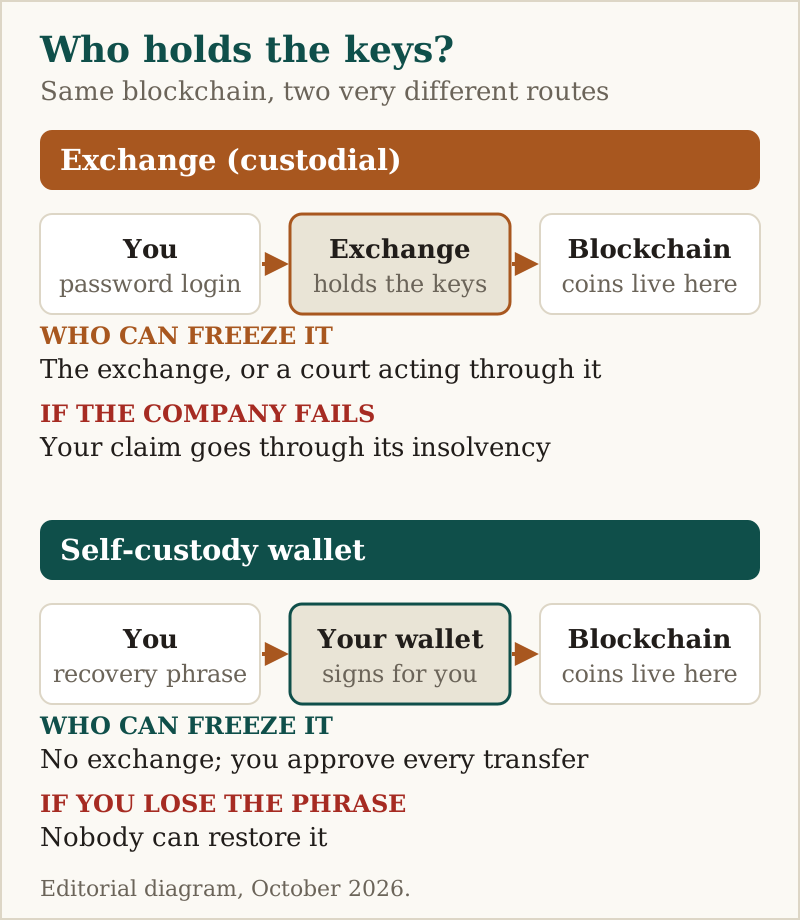
Every bitcoin or ether lives on its blockchain. What you actually own is the ability to move it, and that ability is a private key. "Custody" just means: whose device or vault holds that key? The old slogan "not your keys, not your coins" sums up the diagram below.
What an exchange actually is
A crypto exchange is a business that swaps ordinary money for crypto and back, and one coin for another. For nearly everyone it is the on-ramp, because it connects to a bank account or card. When you leave coins on it, you have an account balance, not keys: the exchange signs every transaction for you. That brings real conveniences, such as password resets, customer support and simple tax documents, along with one structural risk. Your balance is only as good as the company's solvency, security and honesty. Our explainer on Uphold looks at one such custodial app in detail.
What a wallet actually is
A wallet does not store coins; it stores the keys that move them. A self-custody (or "non-custodial") wallet generates those keys on your phone, computer or a dedicated device and backs them up as a recovery phrase, a list of 12 or 24 ordinary words. Whoever has that phrase controls the funds. You get direct ownership and no company in the middle, in exchange for total responsibility: no reset button, no fraud desk, and no way back from a phrase that is lost or stolen.
Plainly put: an exchange is a bank-like promise with a helpline; a self-custody wallet is a safe with no locksmith. Pick the risk you can manage.
Wallet vs exchange, side by side
The table compares the two on the points that matter most to a beginner. "Hot" means software on an internet-connected device; "cold" usually means a hardware wallet that keeps keys offline.
| Exchange (custodial) | Self-custody wallet | |
|---|---|---|
| Who holds the keys | The exchange | You, via a recovery phrase |
| Can buy with dollars or a card | Yes, that is its main job | Usually only through a built-in third-party service |
| Forgot your password | Account recovery with ID checks | Phrase lost means funds lost |
| If the company fails | Your claim goes through the company's insolvency | No company to fail; your coins stay on-chain |
| Who can freeze funds | The exchange, or a court or regulator acting through it | No exchange can; you control every transfer |
| Main risk | Hacks, insolvency, account takeover | Your own mistakes, phishing, malware |
| Typical use | Buying, selling, frequent trading | Holding for longer, using apps on-chain |
Two rows deserve a closer look. Freezing cuts both ways: an exchange can block a thief who has taken over your account, but it can also pause withdrawals for everyone, as several lenders did in 2022. And "no company to fail" is not the same as "safe": a self-custody wallet moves the risk from a company's balance sheet to your own habits.
What happens to your coins if an exchange fails
This is the question most comparison pages skip, and the honest answer is: it depends on the exchange's legal terms, and those terms have not been fully tested in court.
Coinbase is a useful example because, as a listed company, it has to spell this out. Its annual report for 2025, filed in February 2026, says it backs customer holdings one-to-one, aims to keep no more than 2% of custodied crypto in internet-connected "hot" wallets, and structures its user agreements under Article 8 of the US Uniform Commercial Code, under which customer assets it holds are not its own property and should be out of reach of its general creditors. The same report also warns, in its risk factors, that in a bankruptcy customer crypto "could be subject to bankruptcy proceedings" and that customers "could be treated as our general unsecured creditors," because courts have not yet ruled on how these protections apply to crypto. It adds that crypto assets "are not insured or guaranteed by any government or government agency"; only US dollar cash it holds at banks can qualify for deposit-insurance treatment.
You may have read that an accounting rule now protects customers. It does not. In January 2025 the SEC issued Staff Accounting Bulletin 122, effective 30 January 2025, which removed the earlier SAB 121 requirement for custodians to book customers' crypto as a liability on their own balance sheets. That changed how the numbers are presented, not who owns the coins if something goes wrong.
What happened to exchange and lender customers in 2022
The theory became painfully practical in 2022. FTX, then one of the largest exchanges, filed for bankruptcy in November 2022 with billions in customer money unaccounted for. The crypto lenders Celsius, BlockFi and Voyager froze withdrawals the same year and went bankrupt. Customers did not lose everything in every case, but they lost access for years, and in the cases documented below repayment was based on the dollar value of their claims when the company filed, not on the coins they had deposited.
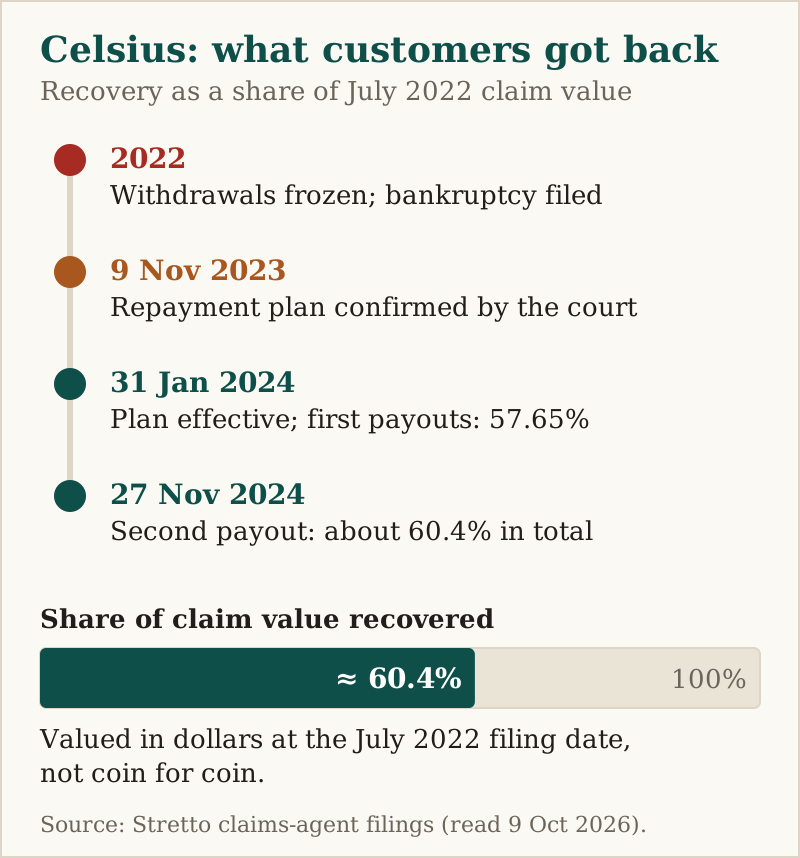
Celsius is the clearest documented case. According to filings published by Stretto, the court-appointed claims agent, its plan was confirmed on 9 November 2023 and took effect on 31 January 2024, when distributions began; the initial recovery for liquid crypto claims was 57.65%, and after a second distribution (notice filed 27 November 2024) eligible creditors had recovered about 60.4% of their claims. Those percentages are of the dollar value of claims at the July 2022 filing date. BlockFi's estate said in July 2024 that clients could expect 100% of the allowed dollar amount of eligible claims, and by March 2025 it reported that almost 97% of US clients had received full distributions. In both cases people waited a long time, and what they got back was set by the dollar value of their claims on the filing date, not coin for coin.
When an exchange is fine, and when a wallet is better
Neither option is "correct." They suit different jobs, and the decision gets easier when you tie it to how much you hold and how often you move it.
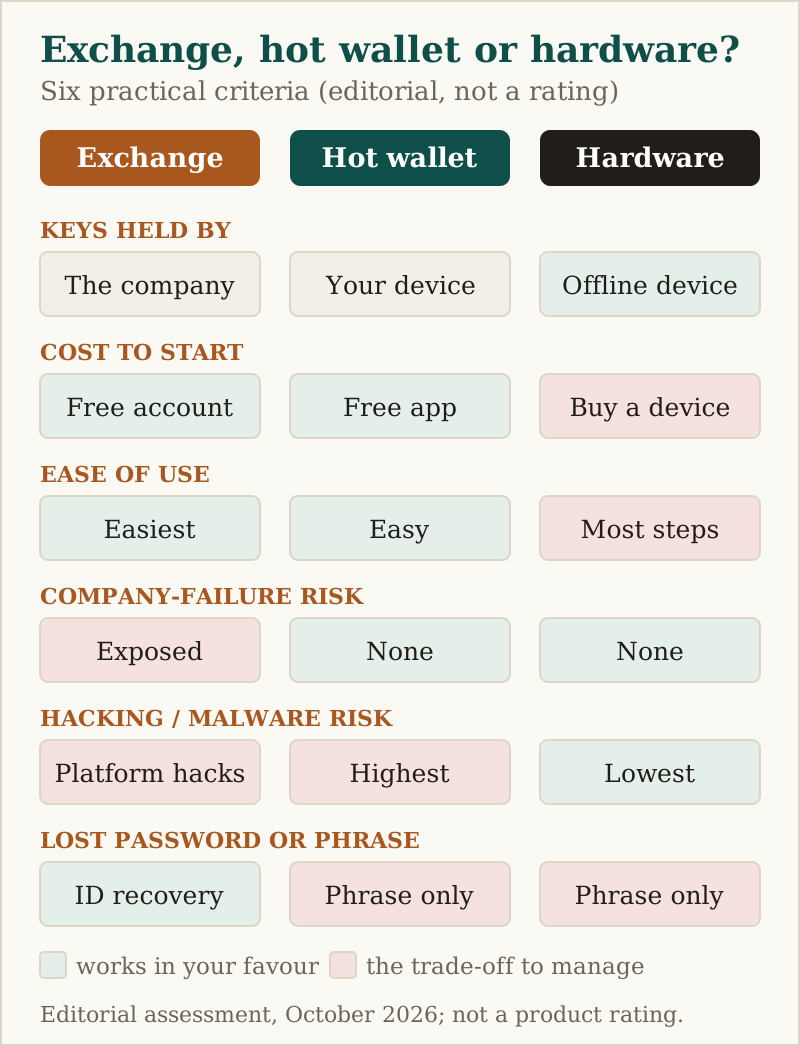
An exchange is a reasonable home when the amount is small enough that losing access for a while would not hurt you, when you trade often, or when you are still learning. Use a well-established, regulated platform, switch on its strongest login protection, and enable any withdrawal allow-list it offers so coins can only go to addresses you have approved.
A self-custody wallet is better once the amount would genuinely hurt to lose, when you plan to hold for years, or when you want to use on-chain applications. A hot wallet suits everyday amounts; a hardware wallet suits savings, because its keys stay offline and every transfer has to be confirmed on the device itself.
What about exchange-linked wallets?
Some exchanges also make self-custody apps, which confuses the picture. Coinbase is the obvious case: its investor site lists "Wallet" and "The Base App" separately from the main buy-and-sell app, and its 2025 annual report describes the Base App (formerly Coinbase Wallet) as self-custodial, with keys stored on the user's mobile device or personal storage accounts rather than with a central company, plus an optional recovery signer. Coinbase's developer documentation, read in October 2026, now calls the product Coinbase Wallet again, "formerly known as Base App." The name is less important than the model: in these apps you hold the keys, so the exchange's account recovery and support do not cover what is inside them.
How to move coins from an exchange to your own wallet
Moving coins off an exchange is simple, but it is also the moment most expensive mistakes happen. Go slowly the first time.
- Set up the wallet first, offline if it is a hardware device. Write the recovery phrase on paper or metal, never in a photo, email or notes app, and store it somewhere safe.
- Copy the receiving address from the wallet itself, and for a hardware wallet, confirm it on the device screen.
- Pick the right network on the exchange. Sending a coin over a network your wallet cannot handle may strand it. If in doubt, choose the coin's native network.
- Check any memo or tag. Some coins need one; for example, the XRP Ledger uses destination tags to identify customers at shared exchange addresses, and a missing tag can lose or delay a deposit.
- Send a small test amount, confirm it arrives, then send the rest. Check the full address each time rather than copying from your transaction history; address-poisoning scams plant lookalike addresses there.
- Expect a hold or a fee. Exchanges can delay withdrawals after a recent deposit. Kraken, for example, says US bank (ACH) deposits carry a seven-day withdrawal hold and card or PayPal buys a 72-hour hold, and it shows the network fee before you confirm.
If you have decided on your own to buy a small amount, the usual route is a large, regulated exchange such as Coinbase or Kraken, then a hardware wallet such as Ledger for anything you plan to keep. Those three are affiliate links, marked sponsored: if you sign up, Plainchain may be paid, you pay nothing extra, and the payment never shapes what we explain. On merit, and paying us nothing, the exchange Bitstamp and the software wallets MetaMask and Trust Wallet are reasonable alternatives. Check what is available in your country, and only put in money you could afford to lose entirely.
Common custody mistakes beginners make
Most custody losses come from a short list of habits, not from clever attacks. Leaving a life-changing sum on an exchange for years treats a company's promise like a vault. Rushing into self-custody and then storing the recovery phrase as a phone photo or in cloud notes hands it to the next piece of malware. Sending to the wrong network or skipping a required memo can strand coins. And trusting anyone who says your funds are "at risk" and must be moved to a "safe wallet" is the core of a widespread phone scam; no genuine exchange support agent asks you to move funds or reveal a phrase. Our guide to common crypto scams for beginners covers the patterns in more detail.
So which should you use?
For most beginners, both, for different jobs and in sequence. Buy on an exchange, because it connects to your bank and handles the complexity. Keep there only what you are actively using. Move anything you intend to hold into a wallet whose recovery phrase you have safely written down, and practise with a small amount before trusting it with more. You do not need to do this on day one; you need to understand the trade-off so that where your coins sit is a decision, not an accident. If you are still at the stage of asking what crypto is for, start with our plain-English guide to what cryptocurrency is and the jargon in our crypto glossary.
Wallet vs exchange: quick answers
What is the difference between a crypto wallet and an exchange?
Is it safer to leave crypto on an exchange or move it to a wallet?
What happens to my crypto if an exchange goes bankrupt?
Do I need my own wallet after buying on an exchange?
Is a Coinbase Wallet the same as a Coinbase account?
New here? Start with what cryptocurrency actually is, or read the whole plain-English primer. None of this is financial advice, and it never tells you what to buy.